 ModelFold
claude-fable-5
Claude Fable 5 is Anthropic’s Mythos-class model for advanced general use, built for long-running coding, complex knowledge work, vision reasoning, and multi-step tasks that require stronger planning and verification.
Pricing: Input 1000 credits / 1M tokens (≈ $5.00), Output 5000 credits / 1M tokens (≈ $25.00).
How can I help you today?
Explore more Chat models

More AI models from Anthropic

Latest and popular AI models
Claude Fable 5 API for Mythos-Class Reasoning, Coding, and Vision
Build with Claude Fable 5 API to handle complex coding projects, autonomous agents, multimodal reasoning, and document-heavy workflows through ModelFold.
What Is Claude Fable 5 and How Is It Related to Claude Mythos
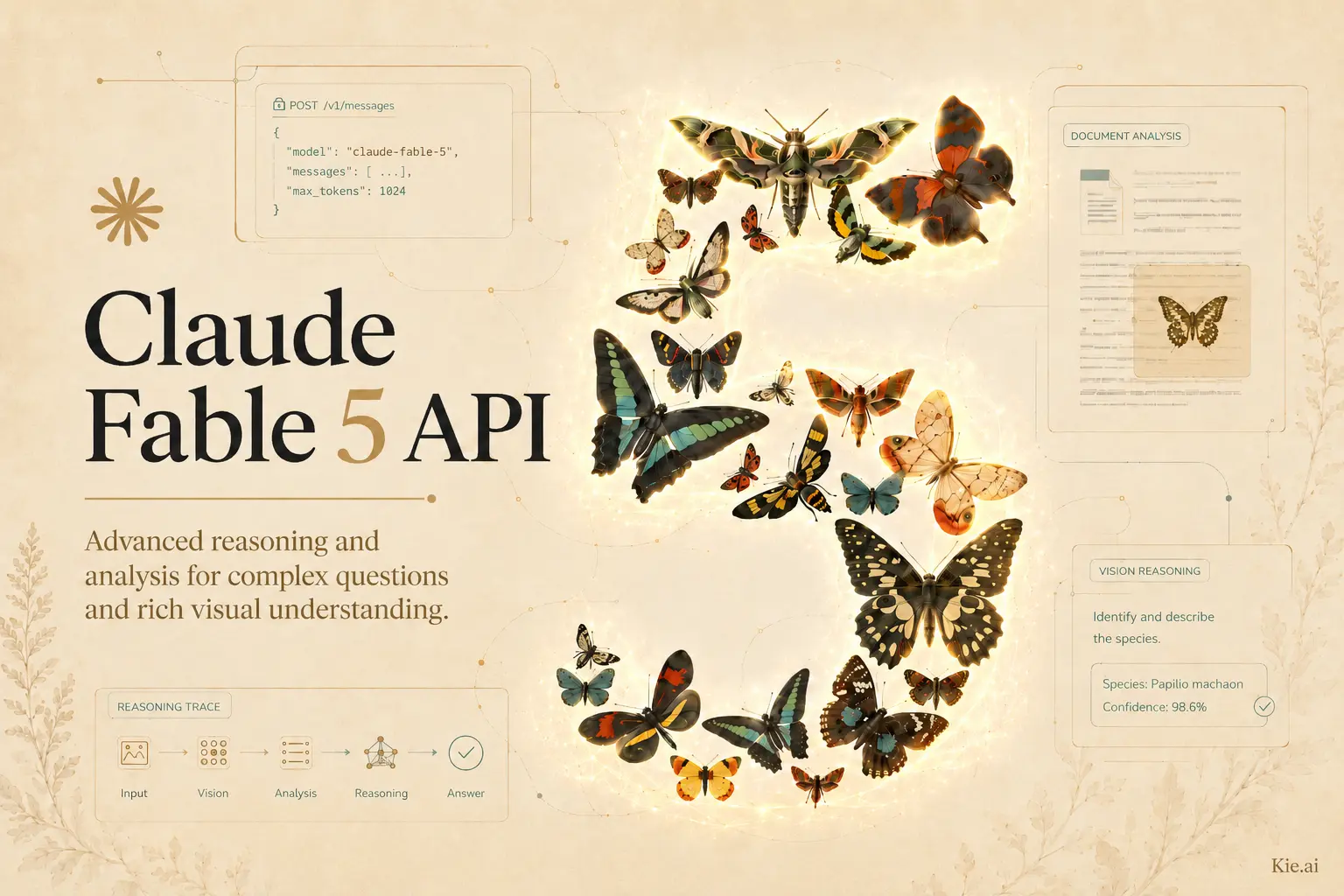
Released on June 9, 2026, Claude Fable 5 is Anthropic’s Mythos-class model built for advanced general use, with stronger capabilities in long-running coding projects, complex knowledge work, vision reasoning, scientific research, and multi-step autonomous tasks. It is designed for workloads that require sustained reasoning over extended context, including software engineering, document-heavy analysis, technical research, and agent workflows where the model needs to plan, verify, and refine its own outputs. Claude Fable 5 and Claude Mythos 5 are closely related at the model-class level, but they are not positioned for the same access scenario. Anthropic describes Fable 5 as a Mythos-class model made safe for general use, while Mythos 5 is discussed in restricted trusted-access contexts with certain safeguards lifted. For developers building production workflows, ModelFold provides Claude Fable 5 API access for advanced reasoning, coding, vision, and enterprise knowledge applications.
Key Features of Claude Fable 5 API
Sustained Reasoning Across Long-Running Tasks with Claude Fable 5 API
Built to stay coherent across long, multi-stage work, Claude Fable 5 API can keep track of goals, constraints, intermediate findings, and revision steps over an extended workflow. This capability is relevant when a task requires continuity, careful planning, and repeated verification before the final output is ready, rather than treating each response as a separate isolated task.
Advanced Code Understanding and Implementation Quality in Claude Fable 5 API
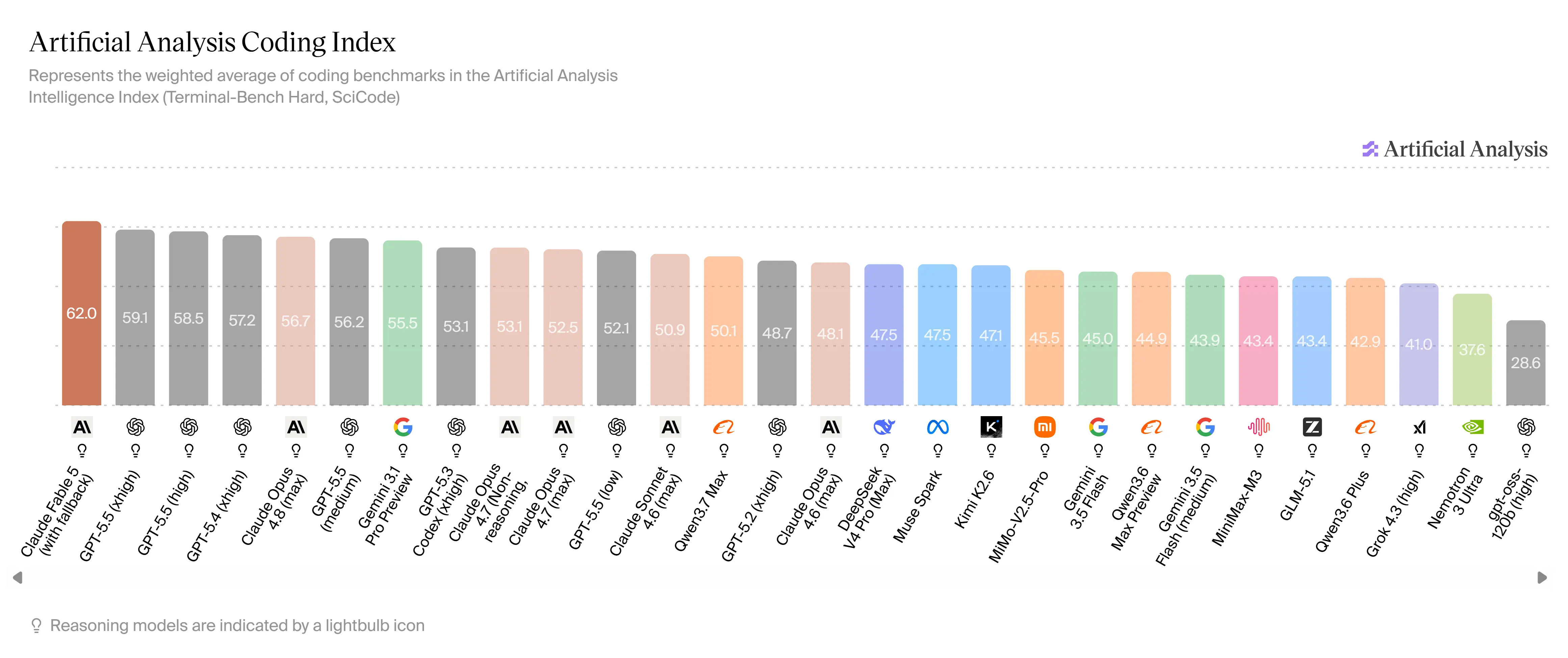
In demanding software engineering contexts, Claude Fable 5 API is designed to support large migrations, complex implementations, debugging, refactoring, and test generation. Its coding strength comes not only from producing code, but also from understanding broader project context, reasoning through dependencies, checking implementation behavior, and using tests or visual feedback to improve the reliability of the result.
Large-Context Knowledge Reasoning with Claude Fable 5 API and 1M Tokens
With a 1M-token context window, Claude Fable 5 API can work with much larger inputs while preserving more surrounding context. This helps when a task depends on long files, extensive research material, repository context, multi-document analysis, or detailed instructions that would be difficult to compress into a short prompt without losing important information.
Vision Understanding for Technical and Document-Based Inputs in Claude Fable 5 API
Beyond text-based reasoning, Claude Fable 5 API can interpret visual information such as diagrams, charts, tables, screenshots, scientific figures, and visual content inside files or PDFs. This gives the model stronger grounding when the answer depends on layout, visual relationships, chart values, interface states, or information that is difficult to represent clearly through text alone.
Safeguards, Fallback, and Alignment Evaluation for Claude Fable 5 API
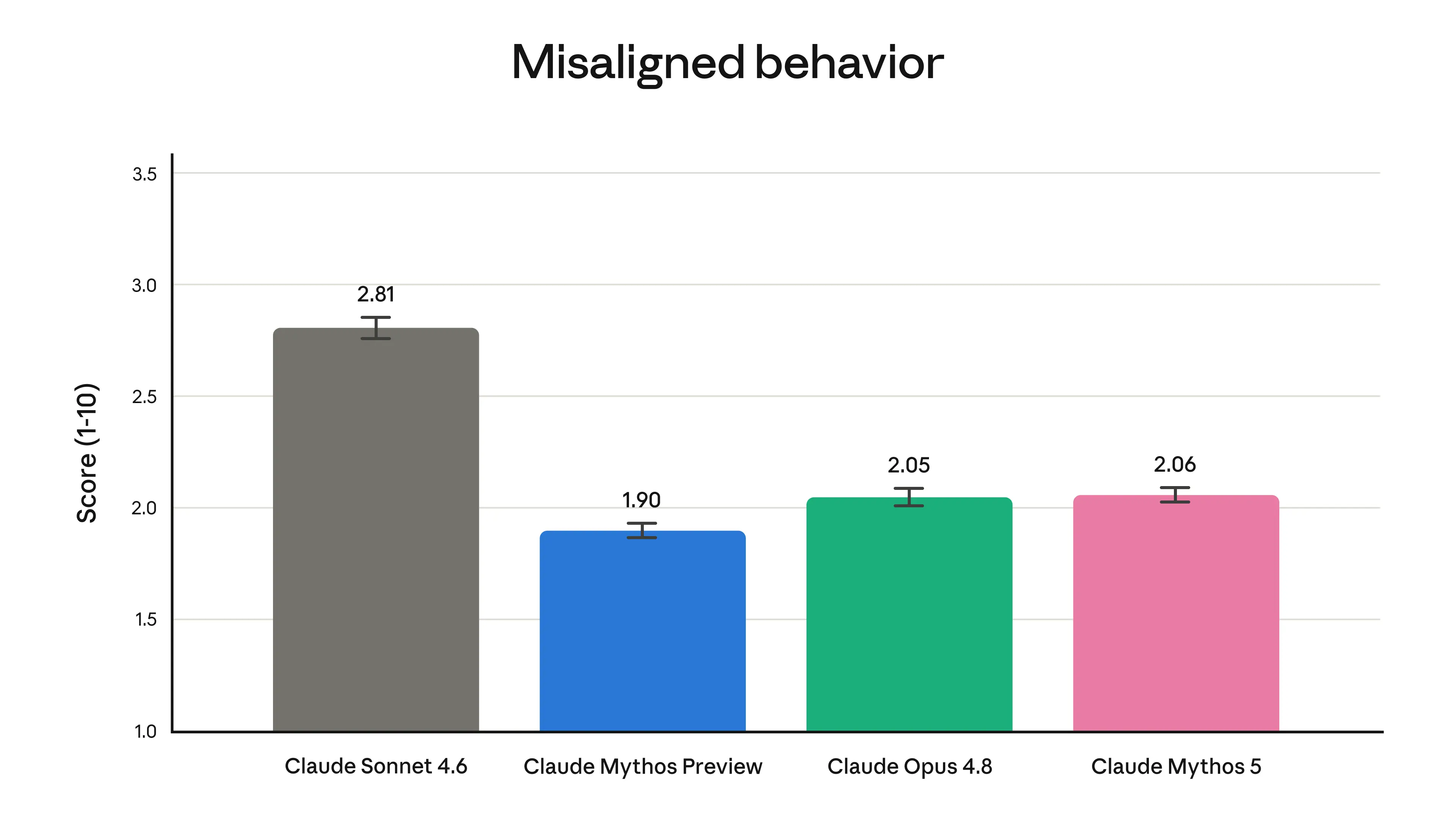
As a generally available Mythos-class model, Claude Fable 5 API includes additional safeguards for sensitive capability areas. Requests related to cybersecurity, biology and chemistry, or distillation may be routed to a fallback model such as Claude Opus 4.8, while the related alignment assessment notes low measured misaligned behavior for Mythos 5 and similar expected behavior for Fable 5 because both are based on the same underlying model.
Claude Fable 5 Benchmark Comparison Against Leading AI Models
Claude Fable 5 benchmark results show strong reported performance against other leading AI models across agentic coding, knowledge work, vision-based reasoning, spatial reasoning, tool use, computer use, legal evaluation, multidisciplinary reasoning, biology, cybersecurity, and health-related tasks. For developers evaluating Claude Fable 5 API, these results are most useful as capability signals for complex coding, long-context reasoning, visual analysis, agentic workflows, and advanced knowledge work. The comparison table below is based on the official Claude Mythos 5 / Fable 5 benchmark table, where reported scores are generally within a 1–3 percentage point difference between Claude Mythos 5 and Claude Fable 5, with the higher score shown. Benchmarks marked with an asterisk require extra caution because safeguards for cybersecurity and biology-related questions can affect Claude Fable 5 results through fallback behavior.
| Benchmark Area | Claude Mythos 5 / Fable 5 | Claude Mythos Preview | Claude Opus 4.8 | GPT 5.5 | Gemini 3.1 Pro |
|---|---|---|---|---|---|
| Agentic coding SWE-Bench Pro | 80.30% | 77.80% | 69.20% | 58.60% | 54.20% |
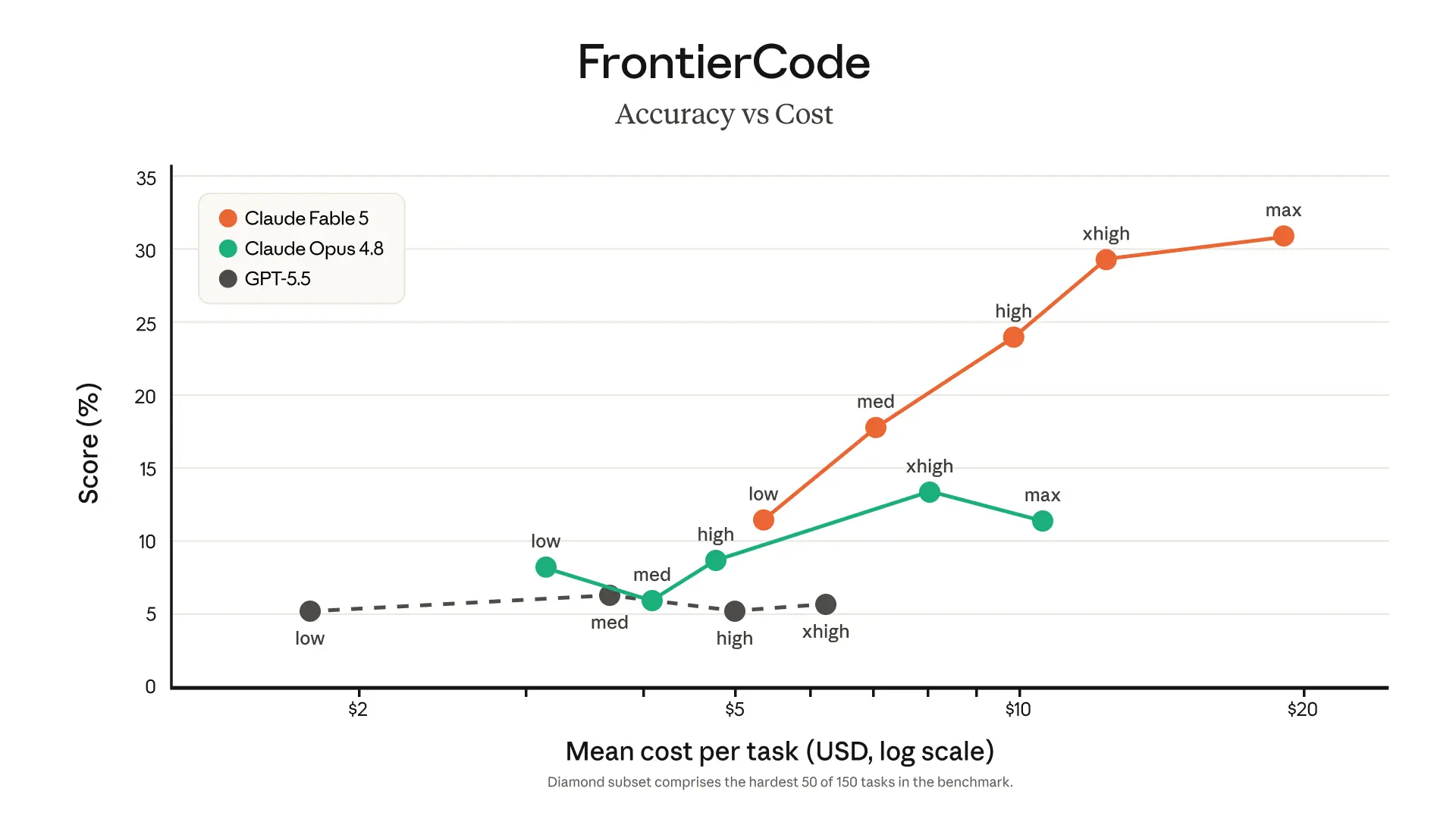
| Agentic coding FrontierCode Diamond | 29.30% | — | 13.40% | 5.70% | — |
| Knowledge work GDPval-AA | 1932 | — | 1890 | 1769 | 1314 |
| Knowledge work vision GDP.pdf | 29.80% | — | 22.50% | 24.90% | 16.70% |
| Spatial reasoning Blueprint-Bench 2 | 38.60% | — | 14.50% | 36.20% | 26.50% |
| Tool use AutomationBench | 17.40% | — | 15.50% | 12.90% | 9.60% |
| Computer use OSWorld-Verified | 85.00% | 85.40% | 83.40% | 78.70% | 76.20% |
| Legal Legal Agent Benchmark | 13.30% | — | 10.40% | 2.10% | 0.00% |
| Multidisciplinary reasoning Humanity’s Last Exam, no tools | 59.0%* | 56.80% | 49.80% | 41.40% | 44.40% |
| Multidisciplinary reasoning Humanity’s Last Exam, with tools | 64.5%* | 64.70% | 57.90% | 52.20% | 51.40% |
| Biology BioMysteryBench, hard | 46.1%* | 29.60% | 40.00% | — | — |
| Biology BioMysteryBench, human solved | 83.9%* | 82.60% | 80.40% | — | — |
| Agentic coding Terminal-Bench 2.1 | 88.0%* | — | 82.70% | 83.40% | 70.70% |
| Cybersecurity ExploitBench(Cap%) | 78.0%* | 69.00% | 40.00% | 34.00% | — |
| Health HealthBench Professional | 66.0%* | 64.70% | 56.90% | 51.80% | — |
Start Building with Claude Fable 5 API on ModelFold
Get started with our product in just a few simple steps...
- 1
Step 1: Get Your Claude Fable 5 API Key
Sign up or log in to ModelFold, then create an API key from your dashboard. Use this key to authenticate Claude Fable 5 API requests from your application, backend service, agent framework, or development environment. Before building a full workflow, review the latest ModelFold API documentation to confirm the current endpoint format, model name, request parameters, input limits, and supported response settings.
- 2
Step 2: Test Claude Fable 5 API with Real Task Inputs
Start with representative prompts instead of simple test messages. Claude Fable 5 API is designed for complex work, so the first evaluation should include tasks such as multi-step coding instructions, long document analysis, chart or screenshot interpretation, structured research synthesis, or agent-style planning. During testing, compare output quality, reasoning depth, formatting stability, fallback behavior in sensitive categories, and whether the model can preserve task context across longer inputs.
- ✓
Step 3: Integrate Claude Fable 5 API into Production Workflows
After testing, connect Claude Fable 5 API to the workflow where its strengths are most relevant, such as coding agents, repository analysis, enterprise document review, research assistants, visual reasoning tools, or internal automation systems. Use clear task boundaries, structured output requirements, logging, and human review for important decisions, especially when the workflow involves long-running tasks, sensitive materials, or outputs that may affect production systems.
Where Claude Fable 5 API Fits in Complex AI Workflows
Codebase Migration Projects with Claude Fable 5 API
Claude Fable 5 API can support large codebase migration workflows where the model needs to understand existing structure, follow implementation constraints, reason across dependencies, and help generate migration plans or code changes. It is especially relevant when a project involves many files, legacy patterns, test updates, and repeated verification steps rather than a simple one-file edit.
Design-to-Code Review Using Claude Fable 5 API
Claude Fable 5 API can help review whether a frontend implementation matches a screenshot, mockup, product brief, or visual reference. By combining code reasoning with visual input understanding, it can support workflows that check layout consistency, identify UI mismatches, explain visual defects, and connect design requirements with implementation details.
Financial and Business Document Analysis with Claude Fable 5 API
Claude Fable 5 API can be used for workflows that involve long reports, financial materials, charts, tables, spreadsheets, business plans, and internal analysis documents. It can help extract key points, compare evidence, organize assumptions, and prepare structured summaries or review notes for analysts, operators, or decision-making teams.
Legal and Policy Review Workflows with Claude Fable 5 API
Claude Fable 5 API can assist with document-heavy review tasks involving contracts, policy documents, compliance materials, internal guidelines, and legal research notes. It can help compare clauses, identify important obligations, summarize risks, and turn dense materials into clearer review drafts while leaving final judgment to qualified professionals.
Research Synthesis and Technical Report Drafting with Claude Fable 5 API
Claude Fable 5 API can support research workflows that require reading across papers, technical files, experimental notes, charts, diagrams, and long-form references. It can help organize findings, compare methods, explain technical evidence, and prepare structured report drafts for scientific, engineering, product, or strategy teams.
Internal Agent Workflows Built with Claude Fable 5 API
Claude Fable 5 API can be used as the reasoning layer for internal agents that need to plan tasks, follow multi-step instructions, coordinate subtasks, inspect intermediate outputs, and prepare final deliverables. This makes it relevant for coding assistants, research agents, operations copilots, document review agents, and internal productivity tools that need stronger continuity than a basic chatbot.
What Makes ModelFold Practical for Claude Fable 5 API Integration
Claude Fable 5 API Access in One Multi-Model Platform
ModelFold provides Claude Fable 5 API access inside a broader multi-model platform, making it easier for developers to evaluate advanced reasoning models without building a separate workflow for every provider. When a product needs different models for coding, document analysis, visual reasoning, agent workflows, or structured enterprise tasks, ModelFold helps teams compare Claude Fable 5 API with other available models and decide where it fits best in the overall application.
Clear Claude Fable 5 API Documentation for Faster Integration
Claude Fable 5 API Documentation on ModelFold helps developers check the latest endpoint format, model name, request parameters, authentication method, input requirements, and response settings before implementation. For complex workflows involving long-context inputs, image or file-based context, structured outputs, and agent-style instructions, clear documentation can reduce integration friction and help teams move from testing to application development more efficiently.
Flexible Claude Fable 5 API Pricing with Credit-Based Testing
ModelFold supports credit-based testing for Claude Fable 5 API Pricing, giving developers a practical way to evaluate real prompts before scaling usage. Instead of presenting Claude Fable 5 API as completely free or unlimited, ModelFold makes it easier to test coding tasks, document inputs, visual reasoning, long instructions, and agent-style prompts with available credits before deciding whether the model fits the project’s cost and performance expectations.
24/7 Support for Claude Fable 5 API Development
ModelFold provides 24/7 support for developers working with Claude Fable 5 API, including questions around access, documentation, credits, testing, and integration setup. This is useful for advanced AI workflows where issues may involve long-context behavior, visual inputs, structured response formats, fallback-sensitive scenarios, or application-level debugging rather than simple prompt testing.
FAQs About Claude Fable 5 API
What is Claude Fable 5?⌄
Claude Fable 5 is Anthropic’s Mythos-class model built for advanced general use. It is designed for complex coding, long-running tasks, knowledge work, vision reasoning, scientific analysis, and multi-step workflows that require stronger planning, context retention, and verification than simpler chat models.
How is Claude Fable 5 related to Claude Mythos?⌄
Claude Fable 5 and Claude Mythos 5 are closely related at the underlying model level, but they are positioned for different access and safety scenarios. Claude Fable 5 is described as the generally available Mythos-class model with safeguards, while Claude Mythos 5 is discussed in restricted trusted-access contexts where certain safeguards may be lifted for approved use cases.
What can developers build with Claude Fable 5 API?⌄
Developers can use Claude Fable 5 API for coding agents, codebase analysis, document review tools, research assistants, visual reasoning workflows, enterprise knowledge systems, and internal automation products. It is most relevant when an application needs long-context reasoning, multi-step task execution, structured outputs, or stronger analysis across text and visual inputs.
Is Claude Fable 5 good for coding?⌄
Claude Fable 5 is positioned as a strong model for demanding software engineering work, including large migrations, complex implementations, debugging, refactoring, test generation, and repository-level reasoning. Its coding value is strongest when the task requires broader project context, dependency reasoning, and verification rather than a short code snippet.
Can Claude Fable 5 handle long documents, files, and large codebases?⌄
Claude Fable 5 is designed for long-context work and is described with support for a 1M-token context window. This makes it relevant for long documents, extensive research materials, repository context, detailed instructions, and multi-document analysis. For API implementation, developers should still check the latest Claude Fable 5 API Documentation on ModelFold for current input limits, supported formats, and request rules.
Does Claude Fable 5 understand images, charts, tables, and PDFs?⌄
Claude Fable 5 can reason over visual information such as screenshots, diagrams, charts, tables, scientific figures, and visual content inside files or PDFs. This makes it useful for UI review, design-to-code checking, chart interpretation, visual document analysis, and technical workflows where important information is embedded in layout or images.
Why can Claude Fable 5 trigger fallback behavior?⌄
Claude Fable 5 includes safeguards for sensitive capability areas. Requests related to cybersecurity, biology and chemistry, or distillation may be routed to a fallback model such as Claude Opus 4.8. This behavior is important for developers to understand when building workflows that may involve restricted, dual-use, or highly sensitive topics.
Is Claude Fable 5 API suitable for production applications?⌄
Claude Fable 5 API can be suitable for production applications that require advanced reasoning, coding support, document analysis, visual understanding. For production use, developers should define task boundaries, validate outputs, monitor fallback-sensitive cases, and include human review where results may affect business, legal, engineering, or operational decisions.
Where can I check Claude Fable 5 API Pricing and documentation?⌄
Developers should check the latest Claude Fable 5 API Pricing and Claude Fable 5 API Documentation on ModelFold before implementation. Pricing, credit rules, endpoint formats, model names, request parameters, supported inputs, and usage details may change, so the current ModelFold documentation should be treated as the final reference before production use.
| Input | 1000 credits 1M tokens≈ $5.00 |
| Output | 5000 credits 1M tokens≈ $25.00 |
Billed per token: input and output are priced separately, and thinking tokens count as output. The Playground charges exactly the same way.
Read API docs →curl https://ai.modelfold.online/v1/chat/completions \
-H "Authorization: Bearer $MODELFOLD_API_KEY" \
-H "Content-Type: application/json" \
-d '{"model":"claude-fable-5","messages":[{"role":"user","content":"Hello"}]}'