 ModelFold
claude-opus-4-7
Claude Opus 4.7 delivers stronger agentic coding, sharper visual understanding, precise instruction following, and sustained reasoning for complex professional tasks requiring reliability, context awareness, careful multi-step execution, and polished outputs.
Pricing: Input 356.25 credits / 1M tokens (≈ $1.78), Output 1787.5 credits / 1M tokens (≈ $8.94).
How can I help you today?
Explore more Chat models
More AI models from Anthropic
Latest and popular AI models
Claude Opus 4.7 API for Advanced Coding and Multimodal Reasoning
Build more capable AI workflows with Claude Opus 4.7 API on ModelFold, designed for complex coding tasks, detailed visual understanding, structured document analysis, and reliable multi-step reasoning.
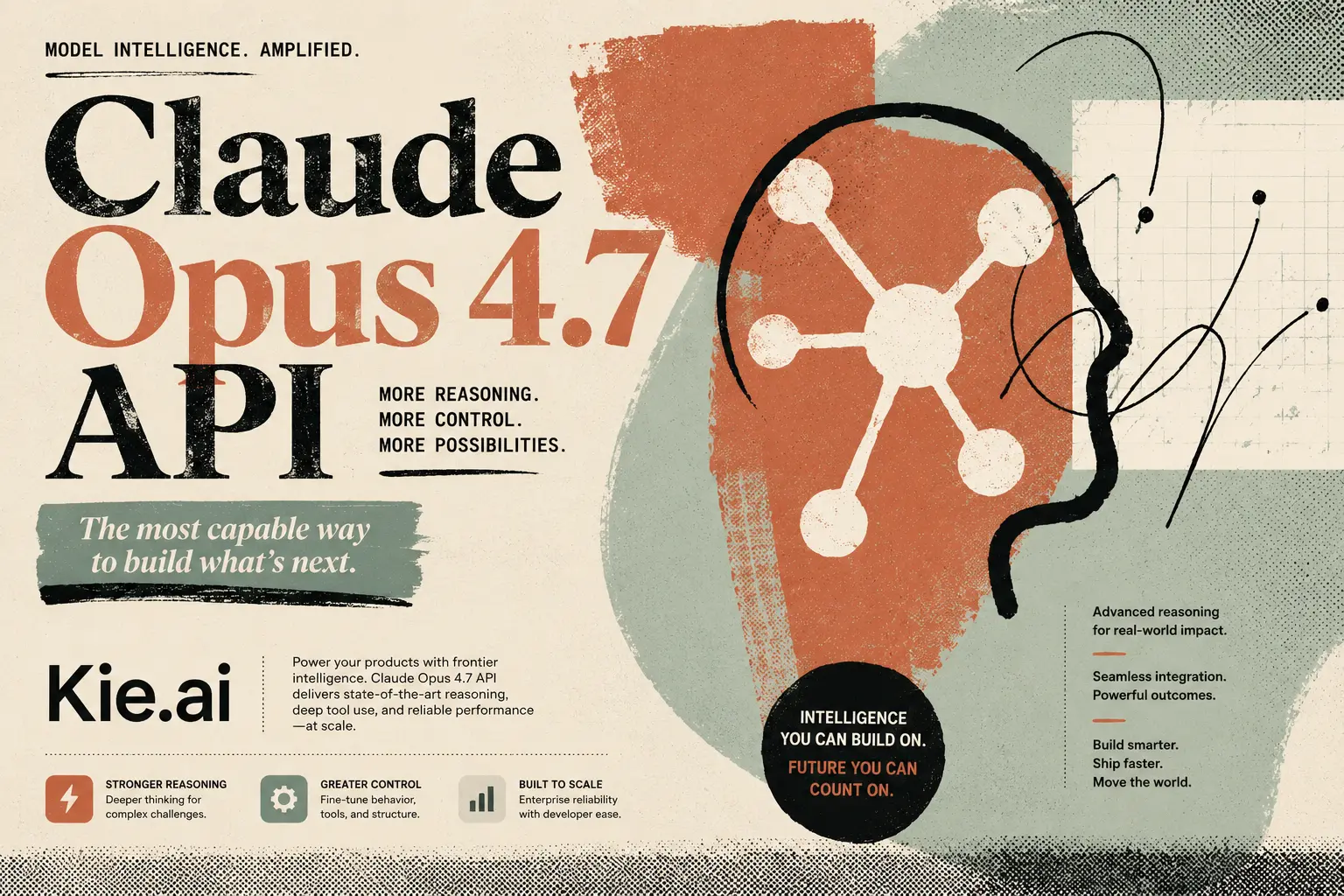
Key Features of Claude Opus 4.7 API
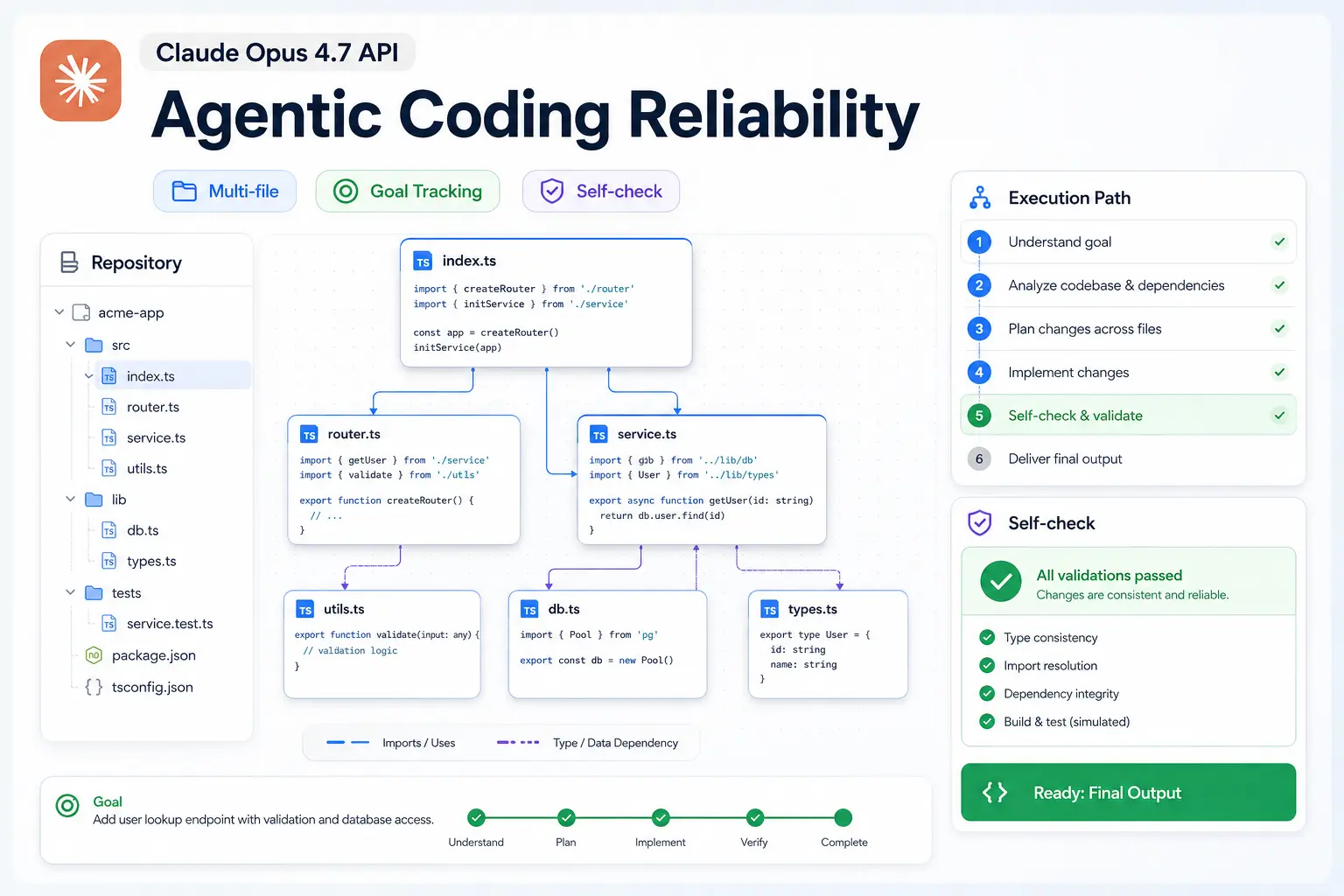
Claude Opus 4.7 API Agentic Coding Reliability
Claude Opus 4.7 API improves agentic coding reliability when a task involves multiple files, dependencies, implementation choices, and possible failure points. Coding workflows can benefit from stronger goal tracking, more consistent step-by-step execution, and better self-checking before a final answer is returned. This creates a more structured software problem-solving experience, especially when the task is too complex for simple code generation.
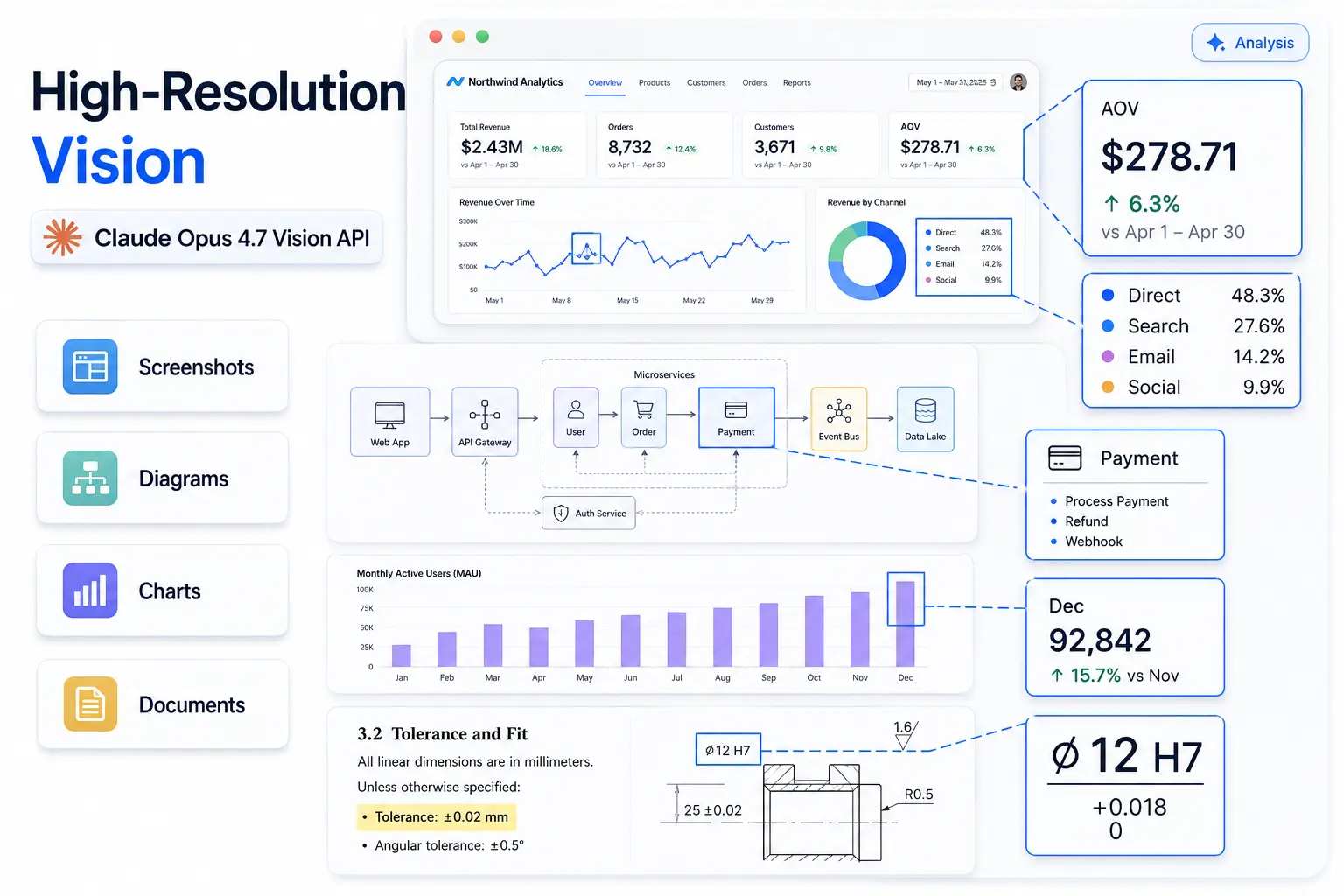
High-Resolution Vision with Claude Opus 4.7 Vision API
Visual understanding becomes more detailed with Claude Opus 4.7 Vision API, especially for dense screenshots, technical diagrams, interface layouts, charts, and document visuals. Higher-resolution vision support helps capture small details, spatial relationships, layout structure, and visual context that may be missed in lower-fidelity image analysis. This matters when visual meaning depends on both text and placement.
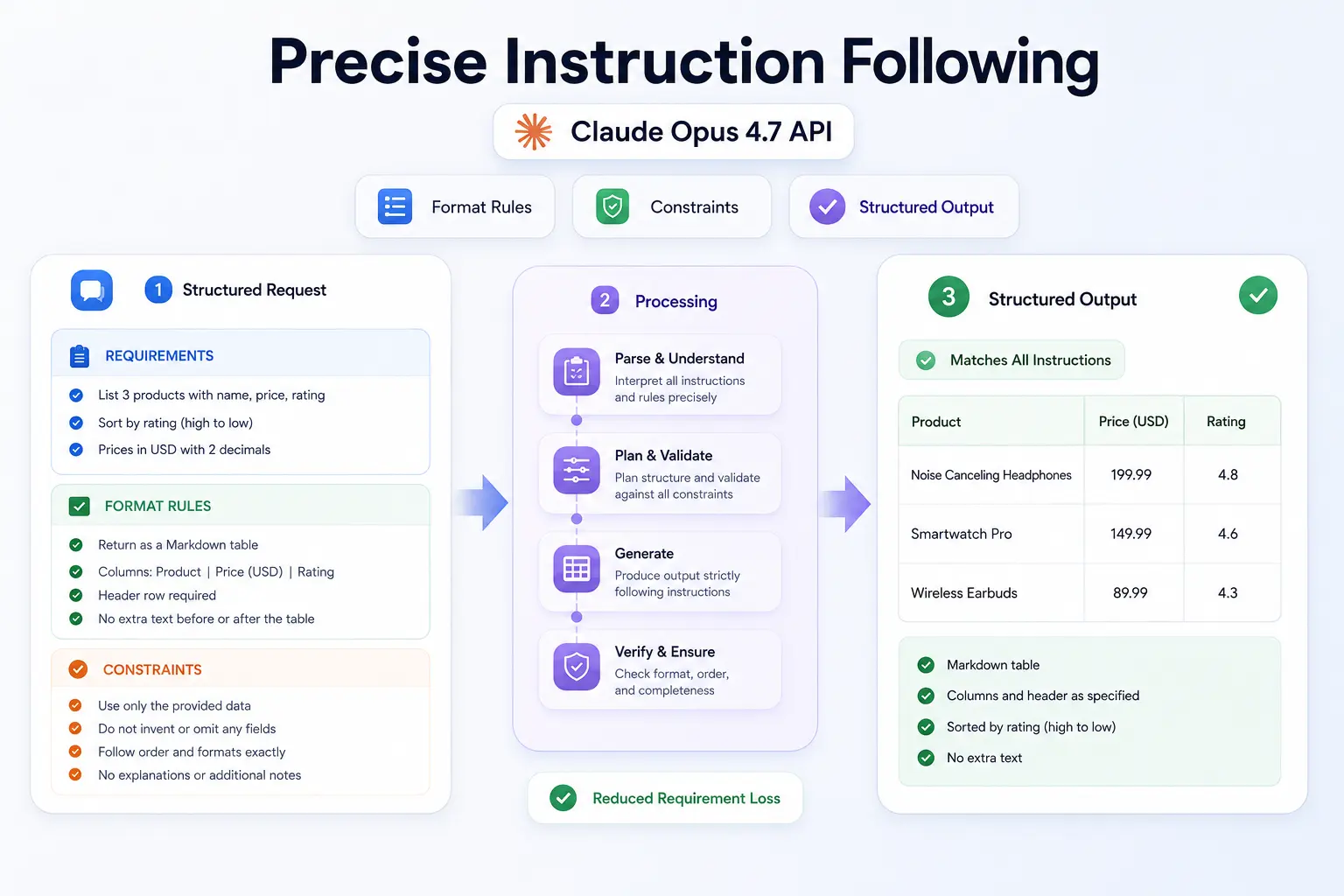
Precise Instruction Following in Claude Opus 4.7 API Workflows
Instruction control is one of the more practical improvements in Claude Opus 4.7 API workflows. Prompts with layered requirements, strict formatting rules, domain constraints, or multi-step logic can be handled more literally and consistently. This helps reduce requirement loss during longer responses and makes structured generation easier to manage in API-based products.
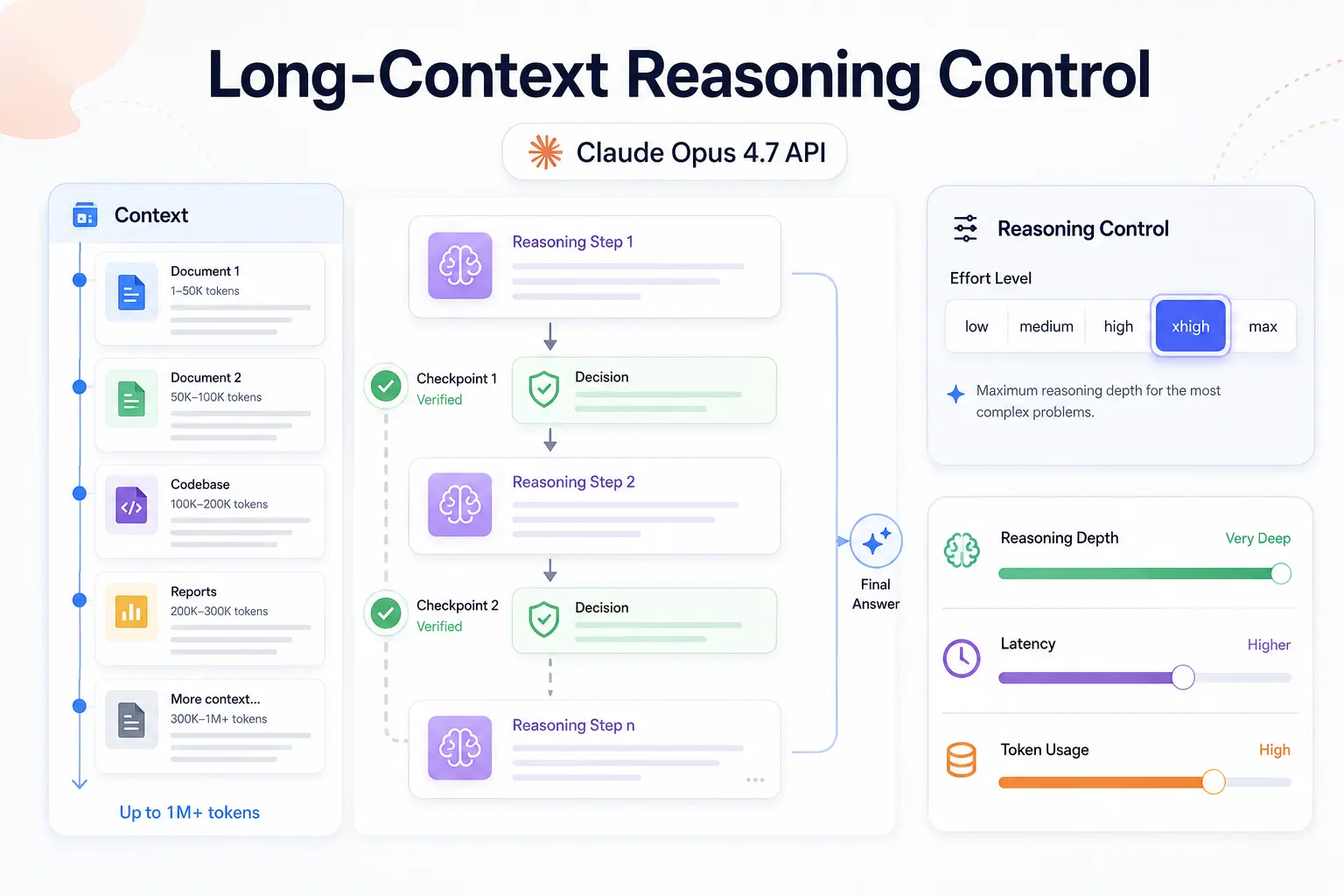
Long-Context Reasoning Control with Claude Opus 4.7 API
Longer reasoning tasks benefit from better context retention, intermediate decision tracking, and careful continuation across multiple steps. Claude Opus 4.7 API also adds the xhigh effort level between high and max, giving developers more room to balance reasoning depth, latency, and token usage for difficult tasks. This makes reasoning control more flexible instead of forcing every hard task into the highest-effort setting.
Claude Opus 4.7 Benchmark Results Compared with Other Leading AI Models
The table below compares Claude Opus 4.7 with Claude Opus 4.6, GPT-5.4, Gemini 3.1 Pro, and Mythos Preview across coding, reasoning, tool use, search, finance, cybersecurity, vision, and multilingual evaluation tasks. All benchmark scores and model labels are based on Anthropic’s official Claude Opus 4.7 benchmark table.
| Evaluation Area | Benchmark | Claude Opus 4.7 | Claude Opus 4.6 | GPT-5.4 | Gemini 3.1 Pro | Mythos Preview |
|---|---|---|---|---|---|---|
| Agentic Coding | SWE-bench Pro | 64.30% | 53.40% | 57.70% | 54.20% | 77.80% |
| Agentic Coding | SWE-bench Verified | 87.60% | 80.80% | — | 80.60% | 93.90% |
| Agentic Terminal Coding | Terminal-Bench 2.0 | 69.40% | 65.40% | 75.1% self-reported harness | 68.50% | 82.00% |
| Multidisciplinary Reasoning | Humanity’s Last Exam, no tools | 46.90% | 40.00% | 42.7% Pro | 44.40% | 56.80% |
| Multidisciplinary Reasoning | Humanity’s Last Exam, with tools | 54.70% | 53.30% | 58.7% Pro | 51.40% | 64.70% |
| Agentic Search | BrowseComp | 79.30% | 83.70% | 89.3% Pro | 85.90% | 86.90% |
| Scaled Tool Use | MCP-Atlas | 77.30% | 75.80% | 68.10% | 73.90% | — |
| Agentic Computer Use | OSWorld-Verified | 78.00% | 72.70% | 75.00% | — | 79.60% |
| Agentic Financial Analysis | Finance Agent v1.1 | 64.40% | 60.10% | 61.5% Pro | 59.70% | — |
| Cybersecurity Vulnerability Reproduction | CyberGym | 73.10% | 73.80% | 66.30% | — | 83.10% |
| Graduate-Level Reasoning | GPQA Diamond | 94.20% | 91.30% | 94.4% Pro | 94.30% | 94.60% |
| Visual Reasoning | CharXiv Reasoning, no tools | 82.10% | 69.10% | — | — | 86.10% |
| Visual Reasoning | CharXiv Reasoning, with tools | 91.00% | 84.70% | — | — | 93.20% |
| Multilingual Q&A | MMLU | 91.50% | 91.10% | — | 92.60% | — |
Start Building with Claude Opus 4.7 API on ModelFold
Get started with our product in just a few simple steps...
- 1
Step 1: Get Your Claude Opus 4.7 API Key
Create or log in to your ModelFold account and generate an API key for Claude Opus 4.7 API access. Store the key in a secure backend environment and avoid exposing it in frontend code, public repositories, browser scripts, or shared client-side files.
- 2
Step 2: Review the Claude Opus 4.7 API Request Format
Before sending requests, check the required fields, supported parameters, authentication method, response structure, and any usage rules shown in the ModelFold documentation. This helps reduce setup errors caused by missing fields, incorrect formatting, or unsupported request configurations.
- 3
CStep 3: Connect Claude Opus 4.7 API to Your Backend
Add Claude Opus 4.7 API to your backend service and configure request authentication, input validation, response parsing, timeout handling, and error management. Backend-side integration keeps the API key protected and gives your application better control over request flow and system reliability.
- ✓
Step 4: Tune and Deploy Your Claude Opus 4.7 API Workflow
After integration, test the workflow with real request samples and review output format, response consistency, latency, and error behavior. Adjust prompts, response schemas, retry logic, and monitoring rules before deployment, then continue checking performance after launch.
Where Claude Opus 4.7 API Creates the Most Value
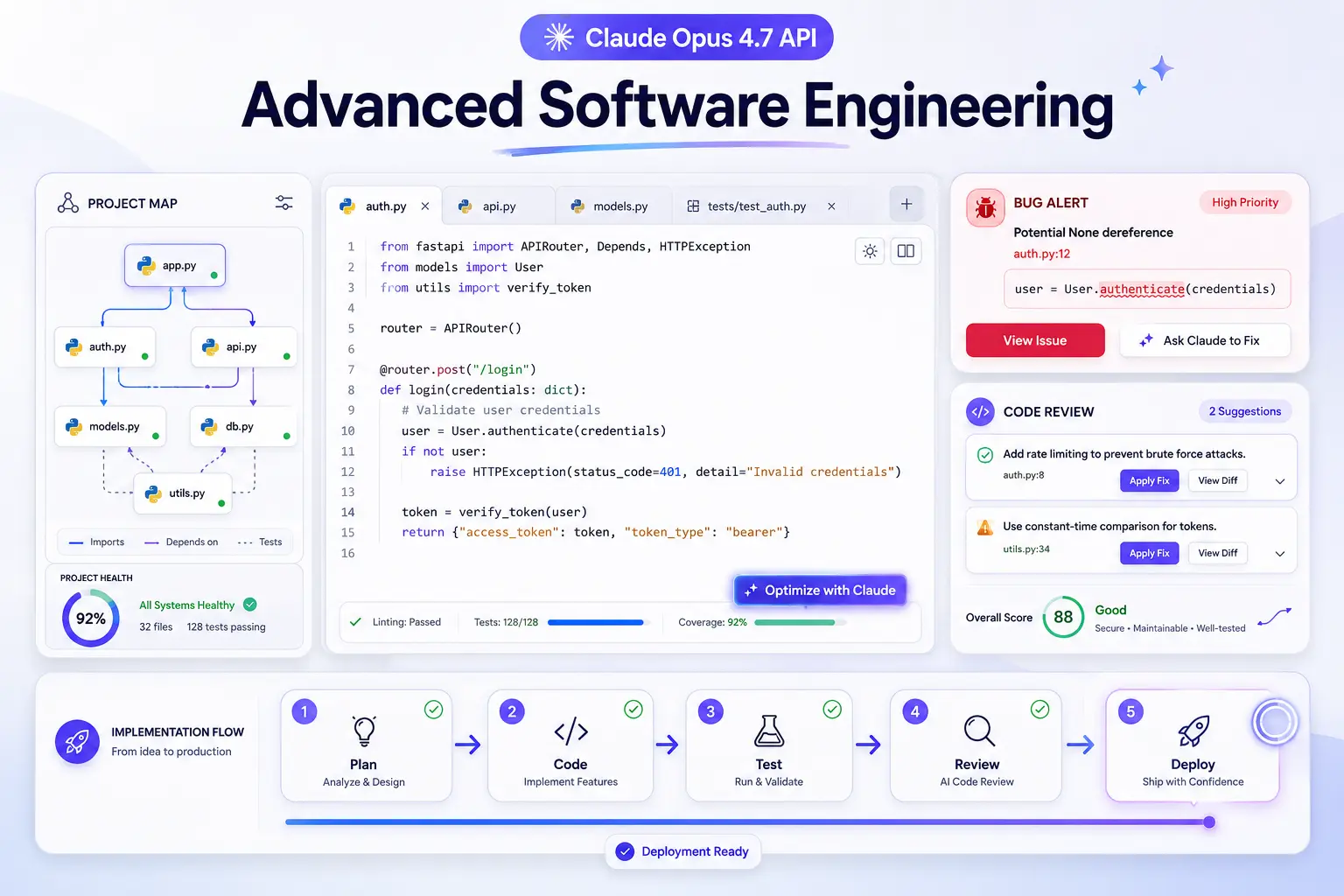
Advanced Software Engineering with Claude Opus 4.7 API
Claude Opus 4.7 API can support software workflows that require planning, debugging, refactoring, code review, and implementation analysis across larger project contexts. Instead of only generating isolated code snippets, it can help break down requirements, reason through dependencies, inspect potential errors, and produce more structured development guidance for complex engineering tasks.
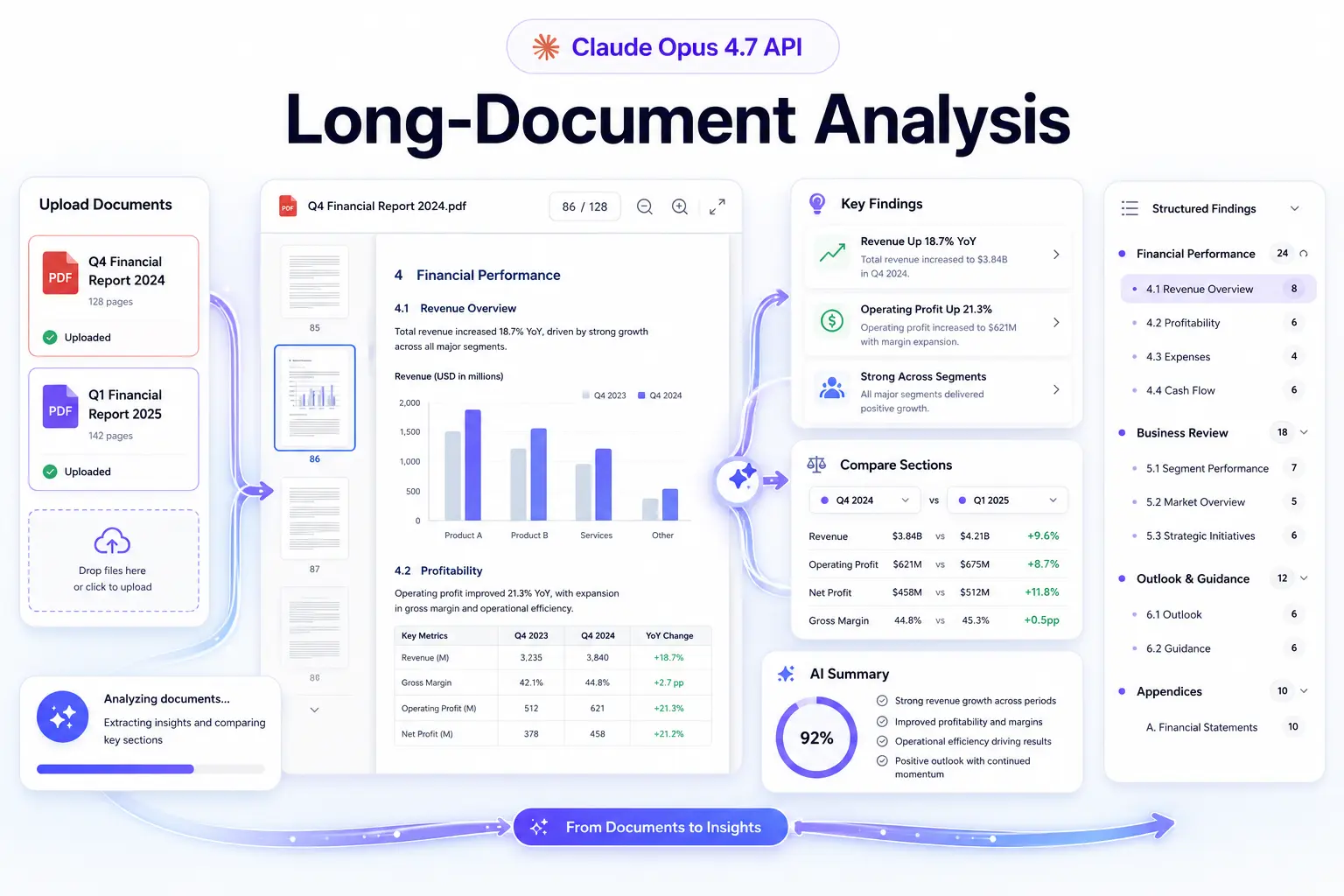
Long-Document Analysis Powered by Claude Opus 4.7 API
Document-heavy products can use Claude Opus 4.7 API to process reports, research materials, policies, technical documents, financial files, and other long-form content. It can help identify key information, compare sections, extract structured findings, explain relationships between details, and turn dense materials into clearer summaries or analysis-ready outputs.
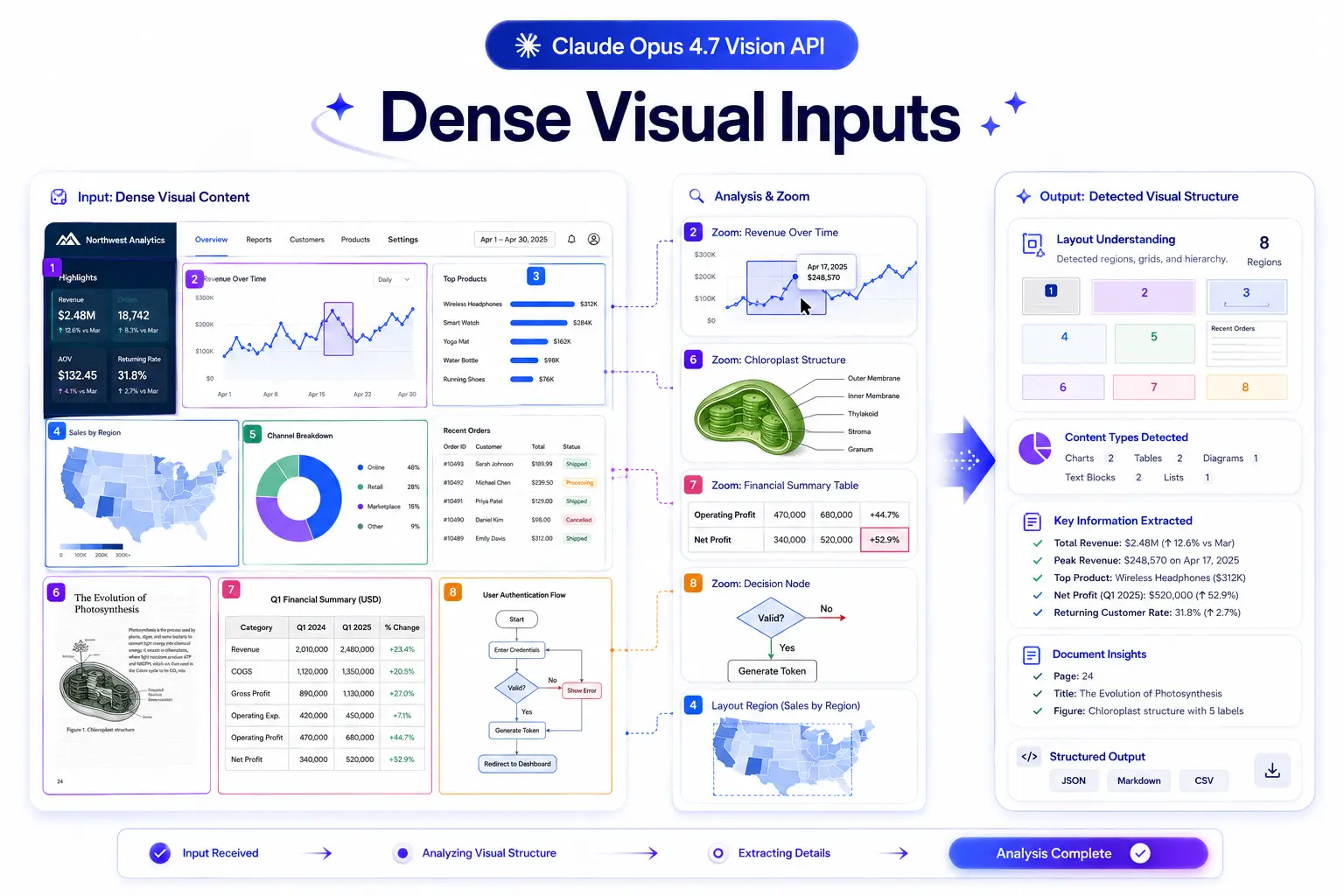
Claude Opus 4.7 Vision API for Dense Visual Inputs
Claude Opus 4.7 Vision API is useful when visual content contains more than simple text. It can work with screenshots, dashboards, charts, diagrams, scanned pages, and interface references where layout, position, and small visual details affect interpretation. This makes it practical for workflows that depend on accurate visual understanding rather than basic image description.
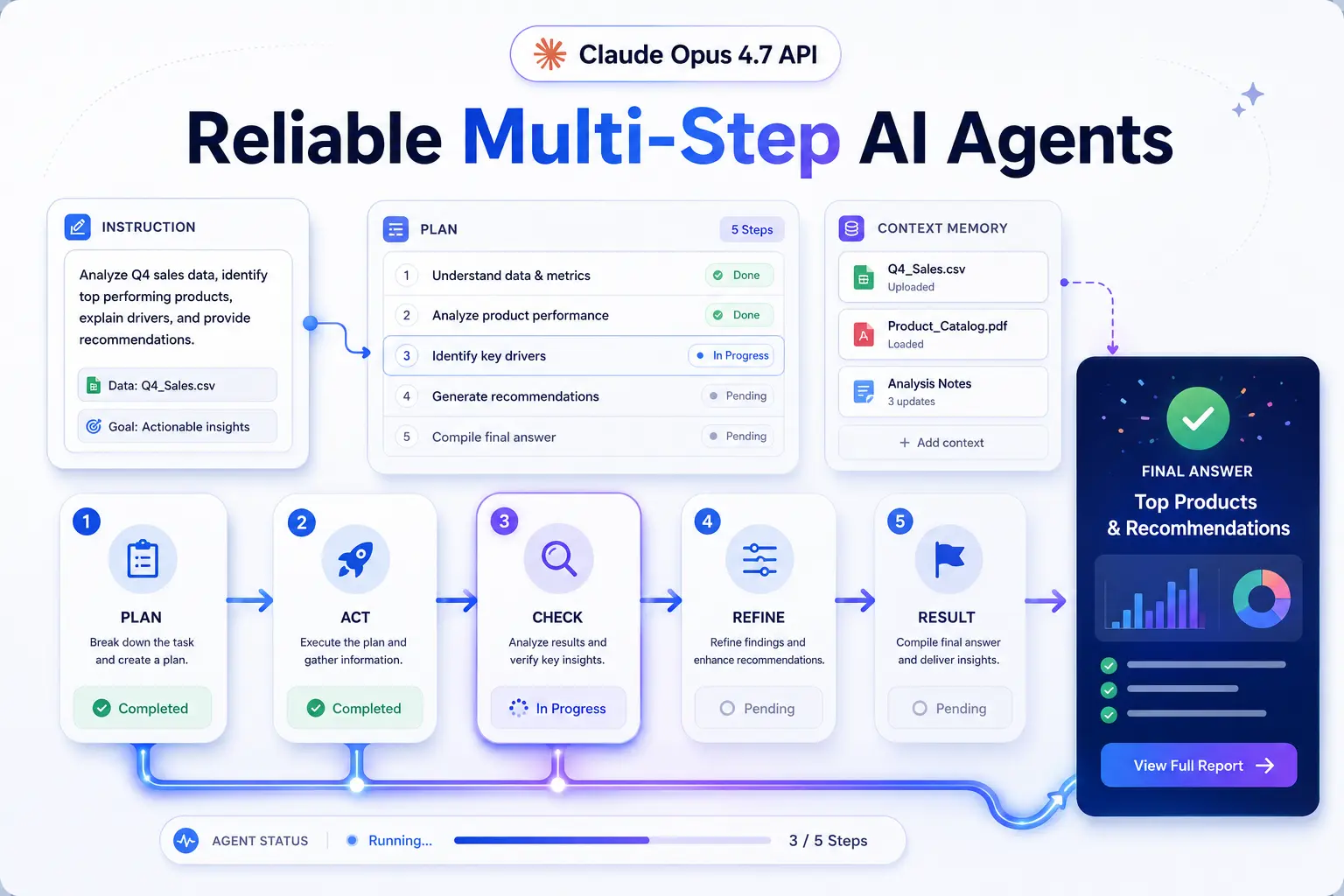
Reliable Multi-Step AI Agents Built on Claude Opus 4.7 API
Claude Opus 4.7 API can strengthen agent workflows that need to follow instructions, maintain context, complete several steps, and check results before responding. This is valuable for systems where the AI must continue through a task carefully, preserve the original objective, handle intermediate decisions, and return a more complete final result.
Why Choose Claude Opus 4.7 API on ModelFold
Flexible Claude Opus 4.7 API Pricing on ModelFold
ModelFold gives developers a practical way to access Claude Opus 4.7 API for different workload sizes, from early testing to production deployment. Instead of committing to a large setup before validation, teams can evaluate request quality, response behavior, and usage patterns first, then scale Claude Opus 4.7 API based on real application demand.
Complete Claude Opus 4.7 API Documentation for Faster Integration
Clear documentation helps reduce integration friction when connecting Claude Opus 4.7 API to an application, backend service, internal tool, or automated workflow. ModelFold provides the necessary API guidance for request setup, authentication, response handling, and implementation details, so developers can move from access setup to working integration more efficiently.
24/7 Claude Opus 4.7 API Access and Service Support
Production AI workflows need stable access, predictable request handling, and support when integration issues appear. ModelFold provides 24/7 service support for Claude Opus 4.7 API, helping developers maintain smoother operation across testing, deployment, and ongoing usage.
More AI Model Options Beyond Claude Opus 4.7 API
ModelFold offers access to multiple AI models, allowing developers to compare Claude Opus 4.7 API with other text, coding, reasoning, image, video, or multimodal models on the same platform. This makes it easier to choose the right model for each workflow instead of relying on a single option for every task.
FAQs About Claude Opus 4.7 API
What is Claude Opus 4.7?⌄
Claude Opus 4.7 is an advanced Anthropic model designed for complex coding, stronger instruction following, high-resolution visual understanding, long-context reasoning, and professional task execution. Compared with Claude Opus 4.6, it improves performance on difficult software engineering work, detailed image analysis, multi-step workflows, and structured knowledge tasks.
How can I use Claude Opus 4.7 API on ModelFold?⌄
You can use Claude Opus 4.7 API on ModelFold by creating an account, generating an API key, reviewing the request format, and connecting the API to your backend service. After setup, you can send requests, process responses, and adjust the workflow based on your application requirements.
Does Claude Opus 4.7 API support image understanding?⌄
Yes. Claude Opus 4.7 API supports stronger image understanding for detailed visual inputs such as screenshots, charts, diagrams, interface layouts, and document images. It can help analyze visual structure, small details, spatial relationships, and layout-based information. For current image input requirements, supported formats, and request parameters, check the latest ModelFold API documentation.
Can Claude Opus 4.7 API handle coding tasks?⌄
Yes. Claude Opus 4.7 API is well suited for advanced coding tasks such as debugging, refactoring, implementation planning, code review, and multi-step software reasoning. It is especially useful when a coding request needs more context, more precise instruction control, and stronger result verification.
Is Claude Opus 4.7 API suitable for long documents?⌄
Yes. Claude Opus 4.7 API can support long-context reasoning and document-heavy workflows. It can help review large materials, compare information across sources, extract structured insights, and produce clearer analysis from complex content.
How should prompts be written for Claude Opus 4.7 API?⌄
Prompts should be specific, structured, and clear about the expected result. A strong prompt usually includes the task goal, relevant context, output format, constraints, and any rules the response must follow. Since Claude Opus 4.7 follows instructions more precisely, older prompts may need adjustment if they were written for looser interpretation.
Where can I find Claude Opus 4.7 API pricing and documentation?⌄
Claude Opus 4.7 API pricing, request parameters, supported formats, authentication details, and integration guidance can be checked in the latest ModelFold API documentation. Reviewing the documentation before deployment helps confirm current access details and avoid outdated implementation assumptions.
| Input | 356.25 credits 1M tokens≈ $1.78 |
| Output | 1787.5 credits 1M tokens≈ $8.94 |
Billed per token: input and output are priced separately, and thinking tokens count as output. The Playground charges exactly the same way.
Read API docs →curl https://ai.modelfold.online/v1/chat/completions \
-H "Authorization: Bearer $MODELFOLD_API_KEY" \
-H "Content-Type: application/json" \
-d '{"model":"claude-opus-4-7","messages":[{"role":"user","content":"Hello"}]}'